Published: Tuesday 13th October, 2009 | Author: Parm Mann
Products: WikiReader
Companies: Openmoko (All Openmoko content)
Openmoko, a group that "strives to create real change in the world through good socially conscious design", has today announced WikiReader - a handheld device containing some three million English-language articles from Wikipedia.
The palm-sized device, pictured below, is designed with simplicity in mind and hopes to be accessible to a wide range of users. It features a basic monochrome touchscreen display, just three buttons, and a price tag of $99.
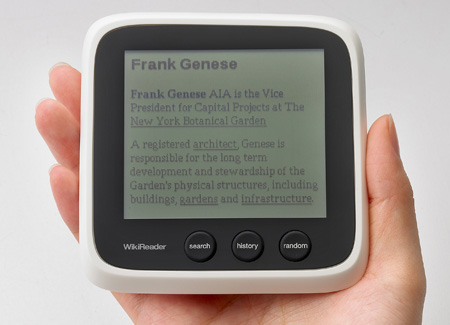
Openmoko claims "WikiReader's screen is fantastic under bright sunlight as well as indoors", and the units source of power - two standard AAA batteries - will allow for roughly one year of usage.
Designed by Thomas Meyerhoffer - formerly of Apple - WikiReader is said to be suitable for children of all ages as a result of built-in parental controls. As an offline device, WikiReader houses its millions of compressed articles on a simple microSD card - updated cards will be launched quarterly, with a yearly subscription plan priced at $29.
The device already has the backing of Wikipedia, with Erik Moeller, deputy director of the Wikimedia Foundation, stating "We've played with WikiReader, and it's a lot of fun to see the entirety of the English Wikipedia text in a self-contained little box that doesn't require Internet access. It could also be one viable approach to share the world's most comprehensive encyclopedia with people who aren't connected. We will watch the continuing development of this device with great interest, as it's fully in the spirit of what Wikipedia is all about: empowering people."
Useful to have around the house when you want to look something up without turning on the PC, we reckon. What do you think? Share your thoughts in the HEXUS.community forums.

Copyright © 1998 - 2010, HEXUS.net. All rights reserved. Terms, conditions and privacy information.
HEXUS® is a registered trademark of HEXUS Limited.

HEXUS.community :: your right2reply
I've changed my mind however. Thinking about who actually uses/reads wikipedia - I would place a bet that the majority of them are more "techie" than most of the population, and they know what wiki is and rougly how it works (basically that its user edited content - NOT from an "official" source). I think that the majority of these people take the information from wiki with that in mind - that it *might* not be 100% trustworthy. It is well known however that you can trust the majority of it anyway and totally incorrect items are usually corrected within minutes or hours.
That last part - the fact that the articles are updated very often to fix issues, almost totally mitigates the fact that some of the info is false, as it will be corrected.
This is not the case with an "offline wikipedia", it will be months before incorrect information is updated..so suddenly your little device is actually untrustworthy as a real data source as soon as you get your updated memory card. This renders it pretty much useless to be honest - and if anything "dangerous" (from an information POV) for the non techie people who may pick one of these up, believing it to be an electronic encyclopedia...
Apologies for the slightly rambly post but hopefully you get my point - I think what could be nice is one that can auto-update when you plug it into the net - would be useful to have out and about in the car etc then, but as has been said..there are so many better ways for implementation than a dedicated device..I think it will die a death alongside all the dedicated ebook readers out there.
Cool but ultimately useless.Quote
Ever wanted to carry three million Wikipedia articles in your pocket? Now you can.
A near fail by Hexus, this has been done years ago...
... but I don't think it hase been updated in a long time...
http://revolution.cx/Lexipedia/Lexipedia.htm
How hard would it be to dump the whole of wiki in html? It would be free and offline for all mobile devices then :)Quote
http://talk.maemo.org/showthread.php?t=33094Quote
Reply