


Networking - the third way
Can you
name three types of networking technology
for making available - anywhere in your home - an internet connection
and PC-based
digital media?
Having listed wireless and wired Ethernet, you might come up short even if you're a networking veteran. But there is a third way and, as our review shows, it could be a far better option for many people, irrespective of what operating system they're using.
Having listed wireless and wired Ethernet, you might come up short even if you're a networking veteran. But there is a third way and, as our review shows, it could be a far better option for many people, irrespective of what operating system they're using.
In the ideal digital home, there would be an Ethernet networking port close to every mains-power socket - the better to have fast internet connectivity in every room and enjoy streaming digital video, music and stills on TV or through an AV system while on the settee or in bed or in the kitchen. Trouble is, few of us live in such a home and even newly-built houses aren't necessarily wired for networking.
So, if we want around-the-home networking and digital media (or even networking between PCs in a couple of rooms), we typically do one of two things.
We might go to the bother of drilling holes through walls and ceilings and running a mess of Cat-5 cabling all over the place - and mess is the operative word. Or we might think that's just too much hassle (or too costly if it's to be carried out by pros) and decide to put up with the vagaries of radio-frequency wireless networking. Perhaps more accurately, we'd decide on buying WiFi gear and only then realise the trouble we'd let ourselves in for!
WiFi can be a swine to set up and won't necessarily work around large homes, especially those with thick brick walls. And, all too often, home WiFi networks are not set up securely. It's not uncommon to be so relieved to have finally got WiFi working that we give up on the security aspects that probably caused us to have so many problems in the first place.
But it may come as big a surprise to learn that there is a viable alternative to wired and wireless home networking - and one that avoids the problems that each entails. Better still, it's available to buy today and can turn any house into something approaching an ideal digital home by having a network connection available in every mains socket, not simply alongside it.
What we're talking about is hardware that uses existing mains wiring to carry the network traffic - and requiring an adaptor for each PC or device that is to be networked directly through the mains. There are a number of mains-borne networking standards - some compatible with one another and some not. Typically, products conforming to the HomePlug family of standards are reckoned to be compatible with one another whereas, it seems, all other standards are incompatible.
For our first look at mains-borne networking, we've turned to HomePlug and specifically to devolo's MicroLink dLAN Highspeed Starter Kit, with a claimed nominal speed of 85Mbps. We plan to carry out further reviews of other HomePlug kit from Solwise, LEA and devolo and also to check out an incompatible but faster (200Mbps) rival system from Corinex called AV200. Confusingly, the HomePlug Alliance is set to launch its own 200Mbps system and, muddying the water still further, this is called HomePlug AV.
Clearly, there's a lot of reviewing still to do but after going hands-on with the devolo kit, we're convinced that HomePlug does offer significant advantages over Ethernet and WiFi - not least of which is its astonishing ease of use compared with WiFi.
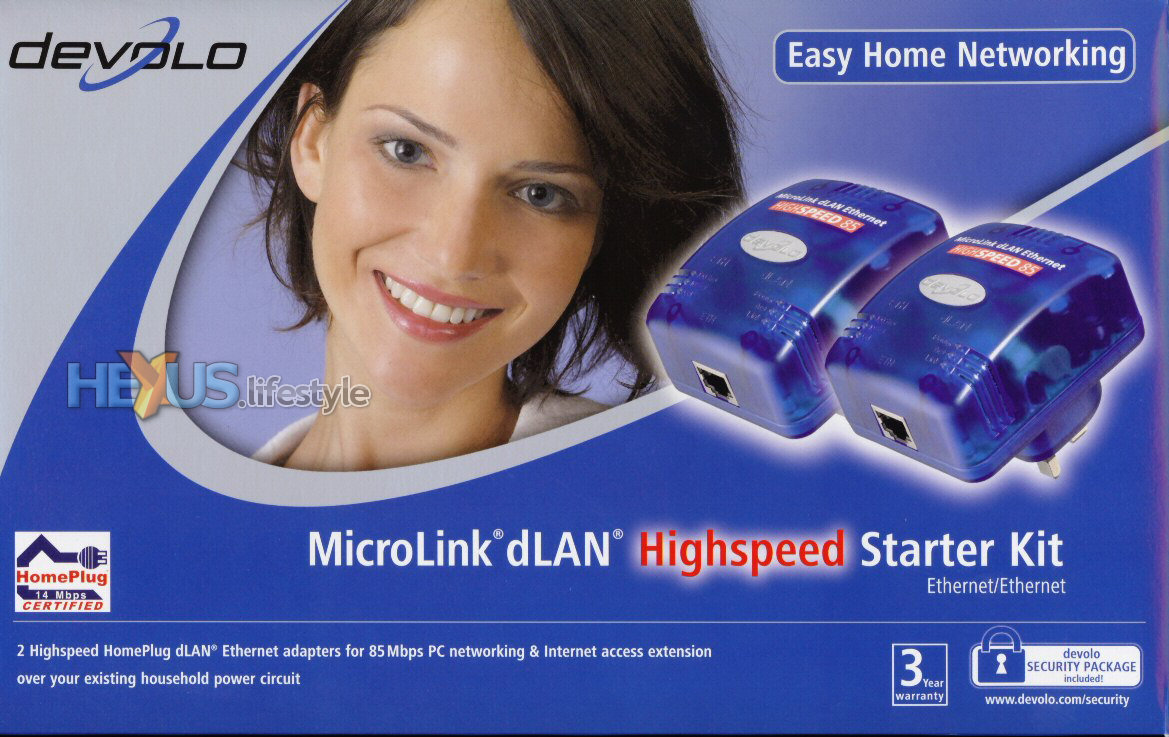 The box should stand out on a
store shelf
The box should stand out on a
store shelf