


Intro
With well over 20 products, PURE looks to offer a bigger spread of DAB radios than any other maker - and a wider variety, too. As well as table-top models, pocket-able and personal-stereo-style portables and a CD/DAB micro system, there's even a separates tuner to go with hi-fi systems. Prices start at under £50 and go up to over £200. We're looking today at a compact, mains-powered table model, the Tempus-1XT, that sits in the middle of the range and can be had for a bit under £100.
Some successful digital technologies grab you first time out. Others grow on your slowly. DAB radio, from our experience of showing it off to a number of people who'd never heard it or had hands-on before, fits firmly into the first category, the more so with those having a keen ear for music.
You'll pay something of a premium for DAB over an analogue FM/AM equivalent - but less than you might assume - and the ranked masses of DAB radios in store attest to the fact that the premium is widely regarded as acceptable and that DAB is the superior option.
A DAB radio will win out every time in terms of its sheer ease of use and usually in sound quality as well - though not perhaps if compared with a good FM tuner being fed by a well-positioned FM roof aerial. But, if the comparison is between table-top or portable models then, typically, it's no contest.
The DAB sound will be crystal clear in areas with decent DAB reception, though if reception's not so hot, there may be no sound at all - DAB being one of those all-or-nothing digital technologies.
Among the goodies you can expect DAB to deliver as standard is a wide selection of stations - all of the BBC's offerings and loads of commercial stations, too. Then there's auto tuning, plus the ability, once the radio's found the stations in its area (which it does automatically when first switched on), to jump from one station to the next with a single click of the tuning knob.
Yes, turning the knob moves directly to the next station along. That's a killer feature for newcomers to DAB because it's just SO much more convenient than the analogue way of turning the knob round and round until you hit a station. And there's more.
You can changes the order in which stations appear as you scroll through them using the tuning knob. Stations can be in alphanumeric order, or with favourite stations followed by the rest in alphanumeric order, or alphanumerically but grouped by multiplexes - sets of stations that are broadcast by different operators.
 The retail pack makes the point
that DAB has loads of stations and that PURE
offers an optional speaker
The retail pack makes the point
that DAB has loads of stations and that PURE
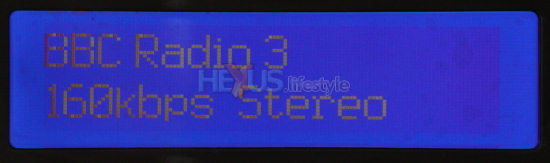
offers an optional speakerIn addition, the digital transmission can carry a whole bunch of useful and worthwhile information that's shown on the radio's display. The quality of reception can also be displayed. Broadcast information can be about the station, the programme (and whether it's mono or stereo) and even the data-rate. The date and time are also transmitted and used by DAB radios to set their internal clocks.
Broadcasters can let you know the name of the performer and the title of the song or provide numbers for phone-ins, text options for mobile-phone messaging or URLs for web sites. What's transmitted is largely down to individual broadcasters and not all of them take full advantage of the possibilities - the BBC typically leads the way and others bring up the rear.
The bottom line with DAB is that no one who's enjoyed decent reception is ever likely to be happy using analogue radio again.
That's DAB in generalities, so let's move on to the specifics of the radio we're reviewing - the PURE Tempus-1XT (why do companies have to put model numbers in superscript like that?) - a product that's said to offer considerably more than its forerunner, the Tempus-1